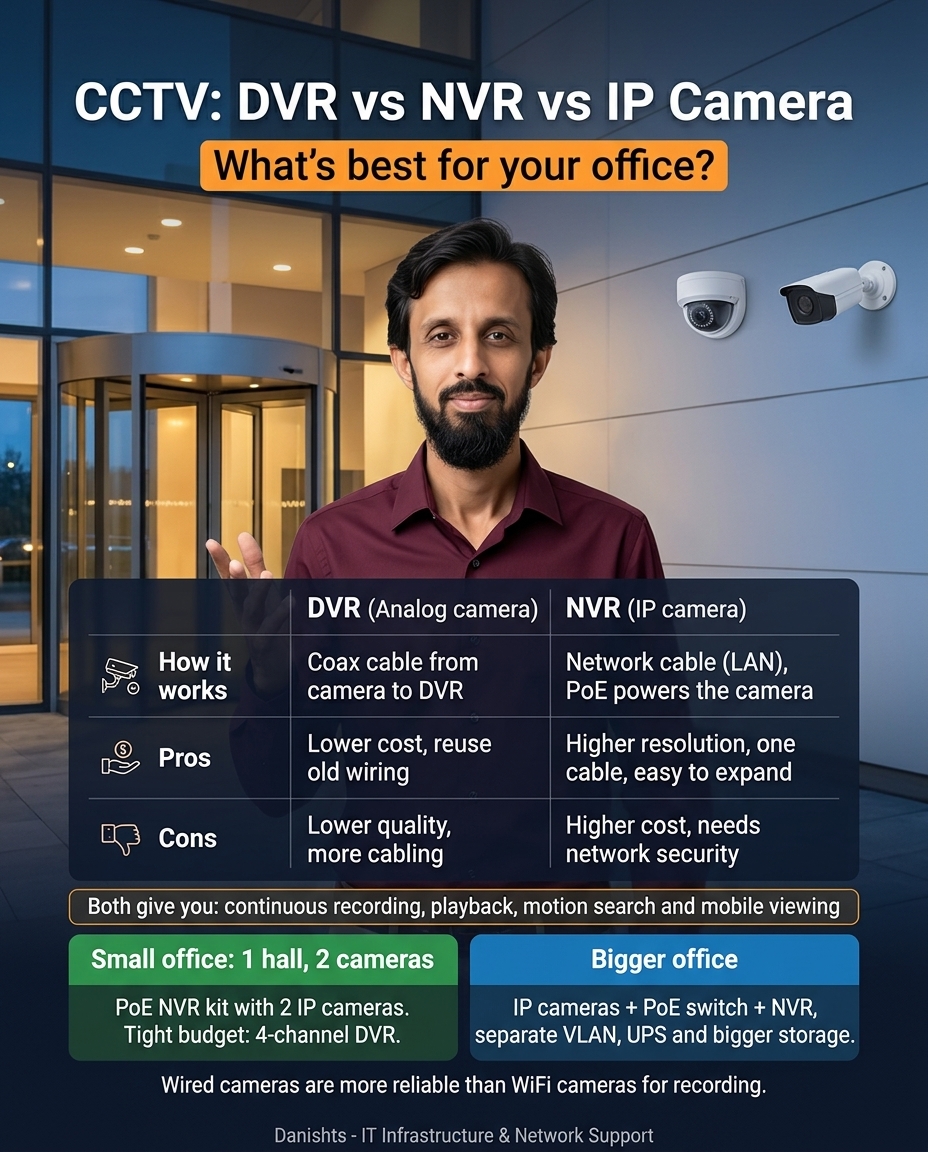
When an office plans CCTV, the first question is usually: DVR or NVR? The answer depends on the type of camera. A DVR works with analog cameras. An NVR works with IP (network) cameras. Here is a simple comparison so you can choose without paying for something you do not need.
DVR with analog cameras
- How it works: a coax cable runs from each camera to the DVR.
- Pros: lower cost, and you can reuse old wiring.
- Cons: lower picture quality and more cabling.
NVR with IP cameras
- How it works: a network (LAN) cable runs from each camera, and PoE powers the camera over the same cable.
- Pros: higher resolution, one cable per camera, and easy to expand.
- Cons: higher cost, and the cameras need network security.
What I would choose
- Small office (1 hall, 2 cameras): a PoE NVR kit with 2 IP cameras. With a tight budget, a 4-channel DVR is a fair choice.
- Bigger office: IP cameras with a PoE switch and an NVR, a separate VLAN for the cameras, a UPS and bigger storage.
Wired cameras are more reliable than WiFi cameras for recording, because recording needs a steady connection. This is the same idea as in LAN vs WiFi in the Office: devices that must always work belong on a cable.
Before you buy: 4 quick checks
- Count the cameras and decide where each one will look (door, hall, parking, cash counter).
- Check the existing wiring. Old coax cable can support a DVR, while IP cameras need network cable.
- Plan the storage. Decide how many days of recording you want to keep, then choose the disk size.
- Plan power and security. A UPS keeps recording during power cuts, and IP cameras must be secured. Read is your CCTV safe from hackers.
Common questions
What is the difference between DVR and NVR?
A DVR records video from analog cameras connected by coax cable. An NVR records video from IP cameras connected over a network cable, and PoE can power the cameras through the same cable.
Is NVR better than DVR?
For most new offices an NVR with IP cameras is the better long-term choice because of higher resolution, one cable per camera and easy expansion. A DVR can still make sense on a tight budget or when good coax wiring already exists.
Do IP cameras need a separate power cable?
Not when you use PoE. A PoE switch or a PoE NVR sends power and data through the same network cable.
Can I use WiFi cameras in an office?
You can, but wired cameras are more reliable for recording. WiFi can drop or get crowded, so use it only where running a cable is not possible.
Is a 4-channel DVR enough for a small office?
For a small space with a few cameras, yes. Count how many cameras you need now and leave room to add more later.
Where I can help
I plan and set up office networks and CCTV network integration in Karachi, on-site, and support clients remotely. See my IT networking and infrastructure services.